We recognize that many—if not most—Basic Income pilots are forced into systems of total financial surveillance and control. In line with the Basic Income Earth Network (BIEN) definition of Basic Income, we stand for absolute freedom of choice in how, when, and where individuals spend their money.
In this context, bitcoin, as a monetary system in the commons, is the only form of money currently available that guarantees this level of freedom by design. Combined with Basic Income, we aim for individual permissionless financial freedom with a floor to stand on.
How did it all start?
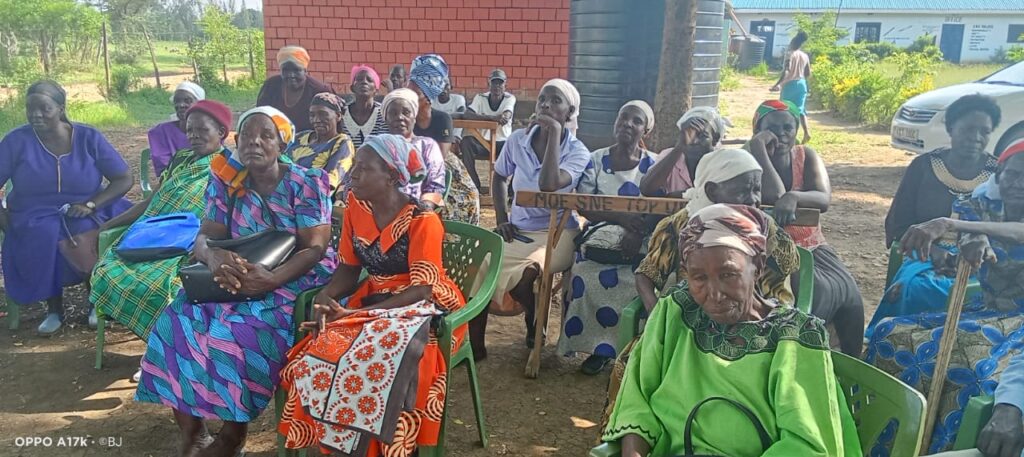
As a first step towards a community driven Basic Income, Mission Possible 2030 started a project in a village in Kenya called Kowiti-A. The project is coordinated by two teachers from the village. In September 2020, ten individuals were drawn in a lottery that the elders of the village had organised. It was an inclusive and transparent process to be given a basic income of 1000 Kenyan Shillings (KES), 10 USD per month for an initial period of one year. This amount was chosen by the communities themselves. To facilitate money transfers, the local coordinators formed a local community-based organisation called Rural Action CBO (RACBO) so that it is a community initiative and money transfers happen in a transparent way. MP2030 transferred money to RACBO which in turn transferred to individuals via M-PESA, which is the popular mobile money transfer platform in Kenya.
When Mission Possible 2030 was approached by a coordinator from Impact Market in 2021, the possibility arose to reach all 415 adults from the village with use of blockchain technology. As the ground in Kowiti-A was already prepared for Basic Income with the local coordinators in the lead, the Kenyan village was an ideal location to start a pilot and see if we could reach the last mile. This learning by doing approach gave a big boost to the project. The protocol used Celo Dollars, or cUSD, a stable-coin whose value is pegged to the Dollar, it was agreed that the pilot would last for at least one year, with a total amount of 400 USD per individual. Together with the community, it was decided to set the amount participants would receive on 7 cUSD a week for every adult in the village, including the ones without a phone.
Reaching the last mile
To ensure the last mile can be reached, one needs to be creative. Ordinarily, you need an app to be able to receive cUSD and therefore a smartphone. As most of the villagers have no smartphone in Kowiti-A, integration with M-Pesa was needed; so-called USSD integration (where cUSD are exchanged for KES in the background, organised by Kotanipay). Someone with a sim card can receive KES, and withdraw cash at an m-pesa shop in the village. One phone can have two sim cards, so two people can receive per phone line. it is not entirely without intermediaries yet, but less than 6% is lost in the transfer from CELO dollar to cash-KES. The local coordinators play a major role in ensuring all adults are included in the project, instructions, guidance and training of the (often illiterate) villagers and assisting in solving technical issues. Personal data (except phonenumbers) was not shared with the tech companies.
An Impact Note from Billy Juma Munda
The current impasse
Unfortunately the transfers ran into problems within a few months, initially due to technical reasons but in the end mainly due to lack of funding from the side of Impact Market. Handing out stable coins does not mean the fund is stable when you hold your assets in a crypto on the online casino. Furthermore, Impact Market has moved from Basic Income towards selling financial products to marginalised people. Long story short: we had to deal with unethical issues and the project was terminated prematurely because promises were not kept.
Next steps
After a few years of silence, research, many conversations and re-aligning with our core-values, the Mission Possible 2030 team has decided to focus on bitcoin only as the ideal form of electronic money that respects the core values behind Basic Income: unconditional (permissionless) individual financial freedom with a floor to stand on.
Doing Basic Income the bitcoin way has never been tested before. We are currently preparing for the first ever combination of the two freedom concepts in practice. Stay tuned